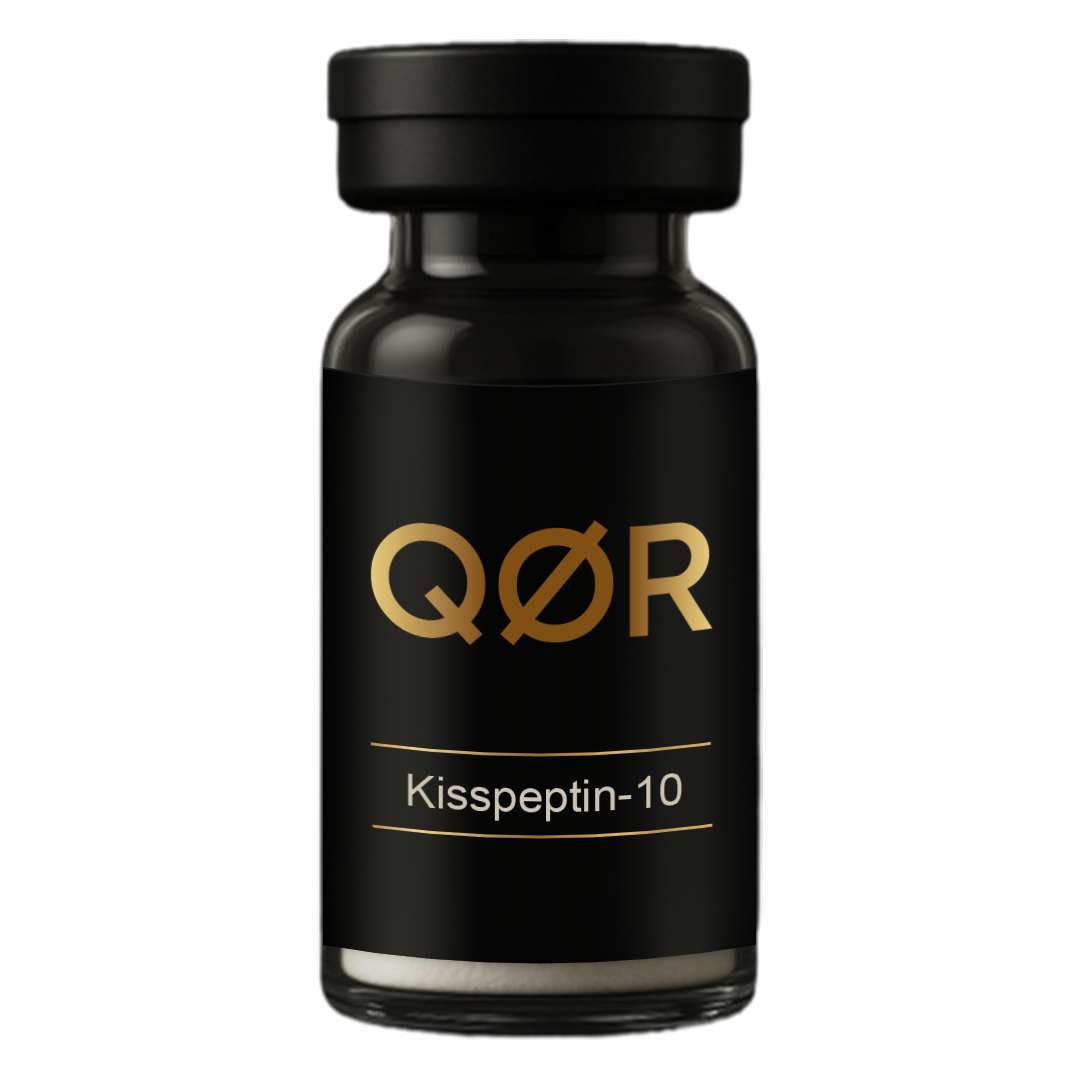
Kisspeptina-10: Un decapéptido bioactivo utilizado para activar el KISS1R (GPR54) en estudios de señalización neuroendocrina y dinámica neuronal de GnRH.
La kisspeptina 10, también conocida como Kp 10, es un decapéptido sintético derivado del fragmento bioactivo del terminal C del producto del gen KISS1. Se suministra como péptido de grado de investigación para su uso en estudios de biología neuroendocrina, señalización celular y farmacología de receptores. Este material está destinado a investigadores cualificados que requieran una fuente definida de ligando activador de KISS1R.
Información molecular y farmacológica
La kisspeptina 10 es el fragmento bioactivo acortado de los péptidos de kisspeptina que se unen al receptor KISS1, también denominado GPR54. El KISS1R es un receptor acoplado a proteína G expresado en tejidos neuroendocrinos y periféricos. En entornos preclínicos y de investigación, la kisspeptina 10 se utiliza como compuesto herramienta para investigar la activación de KISS1R y los resultados de señalización posteriores.
Estos incluyen típicamente sistemas de segundos mensajeros, cambios en la expresión génica y respuestas funcionales en células aisladas y preparaciones tisulares. Las vías de señalización de kisspeptina se han examinado en sistemas modelo que estudian neuronas hipotalámicas, función hipofisaria, regulación metabólica, biología vascular y dinámica de adhesión celular.
Este trabajo tiene como objetivo aclarar los roles de KISS1R en diversos contextos fisiológicos utilizando diseños experimentales controlados.
Uso previsto
Este producto está destinado exclusivamente a experimentos in vitro, preparaciones ex vivo y otras aplicaciones de investigación en laboratorio controladas. Puede utilizarse como un ligando de referencia o un compuesto herramienta en estudios de señalización de receptores acoplados a proteínas G, regulación de vías neuroendocrinas y áreas relacionadas de la biología celular y tisular. No está destinado para uso humano o veterinario.
No está destinado para el diagnóstico, tratamiento, cura, prevención o mitigación de ninguna enfermedad o condición médica. No es un medicamento, alimento, complemento alimenticio, cosmético ni producto sanitario.
Características clave
Decapéptido sintético de kisspeptina 10 adecuado para estudios de activación de KISS1R. Aplicable en ensayos de unión a receptores, ensayos de señalización de segundos mensajeros y trabajos de expresión génica
Fabricado en condiciones controladas con verificación analítica de identidad y pureza
Overview
Kisspeptin peptides also referred to as KISS1 derived ligands or metastin are endogenous signaling molecules studied across vertebrate neuroendocrine and cellular systems.
Kisspeptin 10 is a short C terminal fragment that retains high affinity and functional activity at the KISS1 receptor KISS1R also known as GPR54. The information in this section summarises how Kisspeptin 10 is used as a tool compound in the scientific literature. All observations are model specific and do not constitute safety or efficacy claims for any therapeutic use.
1. Neuroendocrine signaling and GnRH neuron research
A primary focus of kisspeptin research is the control of reproductive axis signaling. In preclinical models Kisspeptin 10 is frequently used to study activation of hypothalamic gonadotropin releasing hormone GnRH neurons. Experimental systems include brain slice preparations immortalised neuronal lines and in vivo rodent models where electrophysiology calcium imaging and immediate early gene markers are used to track GnRH neuron responses to Kisspeptin 10 exposure.
These studies help map KISS1R positive circuits and clarify how kisspeptin input integrates with other neuroendocrine signals regulating reproductive hormone release.
2. Pituitary gonadotropin secretion dynamics
Downstream of GnRH neurons Kisspeptin 10 has been used to probe pituitary function in animal and cell based models.
Researchers examine how KISS1R signaling influences the timing and amplitude of gonadotropin secretion by measuring luteinizing hormone and follicle stimulating hormone responses in controlled settings. These investigations often combine Kisspeptin 10 administration with pharmacologic blockers or genetic manipulations to separate hypothalamic level effects from direct pituitary actions. The resulting data support mechanistic models of how kisspeptin contributes to pulse generation and feedback regulation in the reproductive axis.
3. Metabolic interfaces and energy balance research
Kisspeptin pathways intersect with metabolic signaling which has led to their use in studies connecting energy status to reproductive control. Preclinical work uses Kisspeptin 10 in hypothalamic and peripheral models to examine cross talk with leptin insulin and other metabolic hormones. Endpoints can include changes in neuropeptide expression feeding related behaviors and metabolic biomarkers in animals under different nutritional states. In this context Kisspeptin 10 serves as a tool to probe how KISS1R expressing neurons integrate metabolic and reproductive cues.
4. Vascular biology and peripheral tissue signaling
Beyond the central nervous system kisspeptin signaling has been examined in vascular and peripheral tissues. Kisspeptin 10 is used in endothelial cell cultures vascular smooth muscle cells and ex vivo vessel preparations to study receptor expression second messenger activation and functional responses such as contractility and permeability.
These experiments evaluate how KISS1R activation influences vascular tone cell proliferation and interactions with other vasoactive mediators under defined conditions.
This work is exploratory and aims to position kisspeptin signaling within broader vascular biology frameworks.
5. Cell migration adhesion and tumor biology models
KISS1 was originally identified in the context of metastasis research which continues to guide many cell based studies. Kisspeptin 10 is used in tumor cell lines to investigate effects on migration invasion and adhesion. Assays include scratch wound closure transwell migration matrix invasion and adhesion to extracellular matrix components. Researchers track changes in cytoskeletal organization matrix metalloproteinase expression and adhesion molecule profiles following KISS1R activation.
These studies help clarify how kisspeptin pathways might regulate metastatic behavior in experimental oncology models.
Typical research applications
Across the literature Kisspeptin 10 is commonly used in neuroendocrine studies of GnRH neuron activation pituitary gonadotropin secretion dynamics
metabolic interface research linking energy balance and reproduction vascular biology and endothelial signaling models tumor cell migration adhesion and invasion assays.
In all these settings Kisspeptin 10 functions as a defined KISS1R ligand to dissect receptor driven pathways in controlled experimental systems.
Important research disclaimer
All findings described here come from in vitro experiments ex vivo preparations and animal studies often within tightly controlled protocols. They are provided solely to inform qualified researchers about how Kisspeptin 10 has been used in scientific investigations.These observations do not demonstrate or imply that Kisspeptin 10 is safe or effective for any human or veterinary indication. They are not dosing instructions medical advice or guidance for fertility treatment metabolic disorders vascular disease or cancer. Kisspeptin 10 supplied by us is intended strictly for laboratory research applications. It is not for human or veterinary use and must not be used for diagnosis treatment cure prevention or mitigation of any disease or condition.
Storage Instructions
Store peptides only in professional, controlled environments that operate under their own safety and quality systems. All storage, handling, and disposal must follow your organization’s written policies, risk assessments, and standard operating procedures. It is the responsibility of the facility and its staff to ensure that these policies are in place, understood, and actively followed. Keep vials in a cool, dry location away from direct light, heat, and moisture. Vials should remain upright, sealed, and protected from physical impact so contents and labels stay intact and legible. If your procedures include freezing, use appropriate working volumes and avoid repeated freeze and thaw cycles of the same vial. Do not store peptides near food, drink, or general consumables. Keep them only in designated storage areas with controlled access that reflect your internal governance and regulatory obligations. Handling and preparation must be carried out solely by personnel who are trained and authorized under your institutional guidelines.
Intended use
This product is intended exclusively for in vitro experiments ex vivo preparations and other controlled laboratory research applications including animal studies conducted under appropriate oversight.Typical uses include cell culture assays biochemical experiments on copper binding and transport and investigations of extracellular matrix remodeling and tissue biology. It is not intended for human or veterinary use. It is not intended for diagnosis treatment cure prevention or mitigation of any disease or cosmetic condition. It is not a drug food dietary supplement cosmetic ingredient or medical device.
Retatrutida: Un agonista de triple receptor (GLP-1, GIP y glucagón) destinado a la investigación de la señalización metabólica, la regulación de la glucosa y el balance energético.
GHK-Cu 100 mg: Un complejo tripéptido-cobre utilizado en investigación de cultivo celular para estudiar la remodelación de la matriz extracelular, la angiogénesis y la señalización dependiente de cobre.
Selank 10 mg: Heptapéptido derivado de la tuftsin destinado a la investigación sobre la transmisión GABAérgica, la regulación génica neuroinmune y el metabolismo de neuropéptidos.
Tesamorelina: Un análogo de GHRH de 44 aminoácidos utilizado para investigar la regulación del eje de la hormona del crecimiento, la adiposidad visceral y las interacciones neuroendocrino-metabólicas.
Vistos recientemente
Lo que nuestros clientes dicen de nosotros
Centro de Investigación Académica
La documentación estaba completa, el embalaje era adecuado para nuestras instalaciones y la entrega se ajustó a nuestros plazos internos.
Organización privada de investigación
Registros de lote coherentes y una comunicación técnica clara respaldan nuestros requisitos internos de calidad.
Centro de investigación académica
Desde el pedido hasta la entrega, la comunicación y la documentación han cumplido nuestras expectativas institucionales para la adquisición de materiales de investigación.
Laboratorio de investigación privado
QØR nos ha suministrado materiales de referencia consistentes y documentación de lote clara en múltiples pedidos, lo que respalda nuestro trabajo interno de validación de ensayos