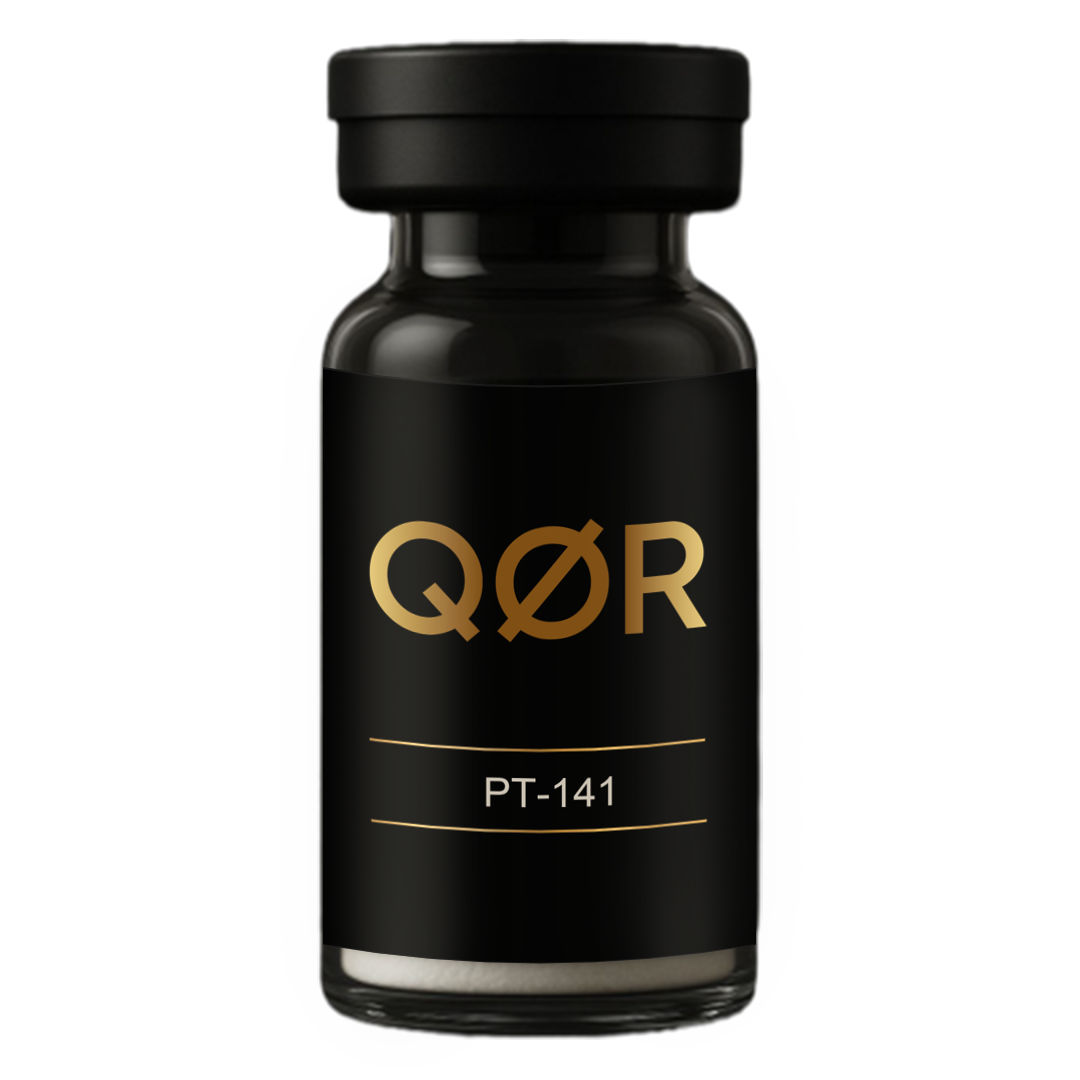
PT-141 10 mg: Agonista sintético del receptor de melanocortina (MC3R/MC4R) utilizado para estudiar la farmacología de los GPCR y las redes de señalización hipotalámica en modelos de laboratorio.
El PT-141 es un agonista sintético del receptor de melanocortina derivado estructuralmente del análogo Melanotan II. Se suministra como péptido de grado de investigación para su uso en estudios de farmacología del receptor de melanocortina central, señalización neuronal y modulación de vías neuroendocrinas.
Información molecular y mecanística
El PT-141 se ha diseñado para interactuar selectivamente con los receptores de melanocortina MC3R y MC4R, que son receptores acoplados a proteínas G expresados en el hipotálamo y otras regiones del sistema nervioso central. En estudios preclínicos y mecánicos, el PT-141 se utiliza como compuesto de referencia para activar estos receptores y caracterizar las vías de segundos mensajeros y las redes de señalización de neuropéptidos. Los trabajos experimentales suelen examinar el PT-141 en modelos que rastrean los mecanismos de control hipotalámico, incluidos los circuitos implicados en la regulación autonómica, el equilibrio energético y la respuesta neuroendocrina. Los ensayos suelen medir la unión al receptor, los eventos de señalización intracelular y los cambios en la expresión génica o peptídica asociados a las vías de la melanocortina en condiciones de exposición controladas.
Uso previsto
Este producto está destinado exclusivamente a experimentos in vitro, preparaciones ex vivo y otras aplicaciones de investigación de laboratorio controladas, incluidos estudios con animales realizados bajo la supervisión adecuada. Las aplicaciones típicas incluyen ensayos de activación de GPCR, investigaciones de señalización neuronal e investigación de modulación neuroendocrina. No está destinado al uso humano ni veterinario. No está destinado al diagnóstico, tratamiento, cura, prevención o mitigación de ninguna enfermedad o afección clínica.
No es un fármaco, alimento, suplemento dietético, cosmético ni dispositivo médico.
Características clave
Agonista sintético del receptor de melanocortina relacionado estructuralmente con el Melanotan II. Actividad selectiva en MC3R y MC4R para estudios dirigidos de GPCR y vías hipotalámicas.
Adecuado para la investigación sobre señalización neuroendocrina, redes centrales de melanocortina y farmacología de GPCR peptídicos.
Overview
PT 141 is a synthetic melanocortin receptor agonist used as a probe for central melanocortin receptor pharmacology. It is applied in controlled systems to study GPCR activation patterns neuronal signaling outputs and neuroendocrine pathway modulation. The points below summarise how PT 141 and related melanocortin ligands are used in preclinical research. All observations are model specific and do not imply any clinical or functional outcomes in humans.
1. Melanocortin receptor pharmacology and ligand receptor selectivity
PT 141 is widely used as an agonist in receptor pharmacology assays that characterise melanocortin receptor activation. In these setups MC3R and MC4R are expressed in recombinant or native systems and PT 141 is applied across a concentration range to generate detailed concentration response profiles. Common endpoints include second messenger production such as cAMP levels phospho protein signatures for pathway activation and receptor internalisation or recycling metrics.
Researchers use these data to compare signaling behavior across melanocortin receptor subtypes evaluate ligand bias toward particular pathways and study receptor desensitisation under repeated or sustained stimulation.
2. CNS relevant signaling networks in animal models
Rodent models provide a platform to map melanocortin receptor linked signaling across central nervous system circuits. PT 141 is administered under defined protocols and downstream molecular endpoints are quantified in hypothalamic and other brain regions. Measured markers can include cAMP regulated transcriptional signatures ERK and other MAPK phosphorylation patterns and immediate early gene expression such as c fos and related indicators of neuronal activation. Pharmacologic blockade and genetic models that alter specific melanocortin receptors are used to attribute observed effects to particular receptor subtypes. This work positions PT 141 as a tool compound for probing how MC3R and MC4R contribute to integrated CNS network activity.
3. Inflammation and host response pathway interrogation
Although PT 141 is primarily associated with MC3R and MC4R there is broader interest in melanocortin pathway involvement in inflammation and host responses.
In immune adjacent models melanocortin ligands are employed to examine how receptor activation intersects with regulation of cytokines macrophage phenotypes and leukocyte signaling. Experimental designs in preclinical infection and inflammation paradigms quantify cytokine linked endpoints leukocyte activation markers and tissue level inflammatory signatures. These studies use melanocortin agonists as probes to characterise cross talk between neuropeptide receptors and immune regulatory networks in vivo and in vitro.
4. Pigmentation linked signaling and photobiology mechanisms
Melanocortin signaling is also central to pigmentation biology through MC1R expressed on melanocytes. In melanocyte focused systems melanocortin ligands are used to study cAMP protein kinase A dependent transcriptional control of enzymes involved in melanin synthesis and melanosome formation. Assays typically evaluate expression and activity of tyrosinase and other melanogenic enzymes melanosome maturation and distribution and cross talk with MAPK cascades. DNA damage response markers and photoprotective signaling components may also be monitored in mechanistic photobiology workflows that incorporate melanocortin pathway activation.
Typical research applications
Across the literature PT 141 and related melanocortin ligands are used in melanocortin receptor pharmacology and ligand selectivity assays
CNS circuit mapping in rodent models using molecular and transcriptional endpoints immune and inflammation related models probing melanocortin host response interactions
pigmentation and photobiology studies that rely on MC1R driven signaling readouts. In all these contexts PT 141 functions as a defined GPCR agonist for mechanistic research not as a finished product for any applied use.
Important research disclaimer
All findings summarised here arise from in vitro systems ex vivo preparations and animal models conducted under controlled protocols. They are presented solely to inform qualified researchers about how PT 141 and melanocortin ligands are used as tools in receptor and signaling research. These observations do not demonstrate or imply that PT 141 is safe or effective for any human or veterinary indication. They are not dosing instructions medical advice or guidance for any functional or clinical application.
PT 141 supplied is intended strictly for laboratory research use. It is not for human or veterinary use and must not be used for diagnosis treatment cure prevention or mitigation of any disease or condition.
Storage Instructions
Store peptides only in professional, controlled environments that operate under their own safety and quality systems. All storage, handling, and disposal must follow your organization’s written policies, risk assessments, and standard operating procedures. It is the responsibility of the facility and its staff to ensure that these policies are in place, understood, and actively followed. Keep vials in a cool, dry location away from direct light, heat, and moisture. Vials should remain upright, sealed, and protected from physical impact so contents and labels stay intact and legible. If your procedures include freezing, use appropriate working volumes and avoid repeated freeze and thaw cycles of the same vial.
Do not store peptides near food, drink, or general consumables. Keep them only in designated storage areas with controlled access that reflect your internal governance and regulatory obligations. Handling and preparation must be carried out solely by personnel who are trained and authorized under your institutional guidelines.
Intended use
This product is intended exclusively for in vitro experiments ex vivo preparations and other controlled laboratory research applications including animal studies conducted under appropriate oversight. Typical uses include cell culture assays biochemical experiments on copper binding and transport and investigations of extracellular matrix remodeling and tissue biology. It is not intended for human or veterinary use. It is not intended for diagnosis treatment cure prevention or mitigation of any disease or cosmetic condition. It is not a drug food dietary supplement cosmetic ingredient or medical device.
$50.00-$95.00Rango de precios: desde $50.00 hasta $95.00
BPC 157: Un pentadecapéptido sintético utilizado en modelos de laboratorio para investigar la angiogénesis, la migración de fibroblastos y la integridad de la barrera mucosa.
SS-31 10 mg: Un tetrapéptido dirigido a las mitocondrias utilizado para analizar la bioenergética dependiente de cardiolipina, la eficiencia del transporte de electrones y la arquitectura de la membrana mitocondrial.
Selank 10 mg: Heptapéptido derivado de la tuftsin destinado a la investigación sobre la transmisión GABAérgica, la regulación génica neuroinmune y el metabolismo de neuropéptidos.
Tesamorelina: Un análogo de GHRH de 44 aminoácidos utilizado para investigar la regulación del eje de la hormona del crecimiento, la adiposidad visceral y las interacciones neuroendocrino-metabólicas.
Vistos recientemente
Lo que nuestros clientes dicen de nosotros
Centro de Investigación Académica
La documentación estaba completa, el embalaje era adecuado para nuestras instalaciones y la entrega se ajustó a nuestros plazos internos.
Organización privada de investigación
Registros de lote coherentes y una comunicación técnica clara respaldan nuestros requisitos internos de calidad.
Centro de investigación académica
Desde el pedido hasta la entrega, la comunicación y la documentación han cumplido nuestras expectativas institucionales para la adquisición de materiales de investigación.
Laboratorio de investigación privado
QØR nos ha suministrado materiales de referencia consistentes y documentación de lote clara en múltiples pedidos, lo que respalda nuestro trabajo interno de validación de ensayos