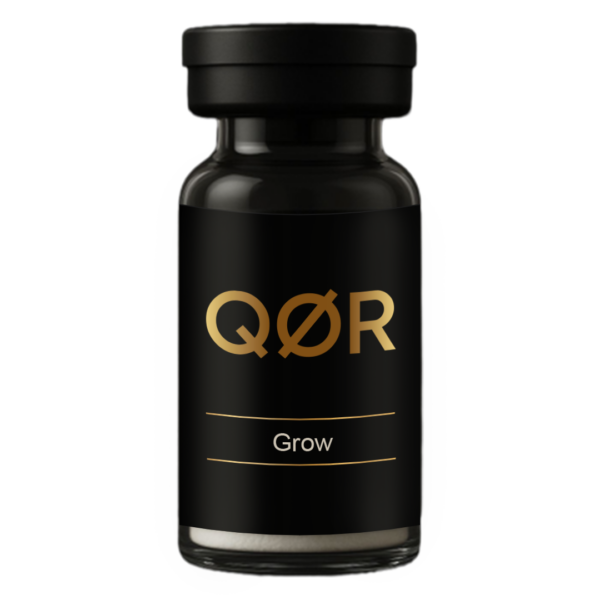
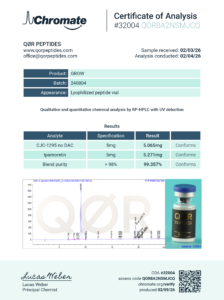
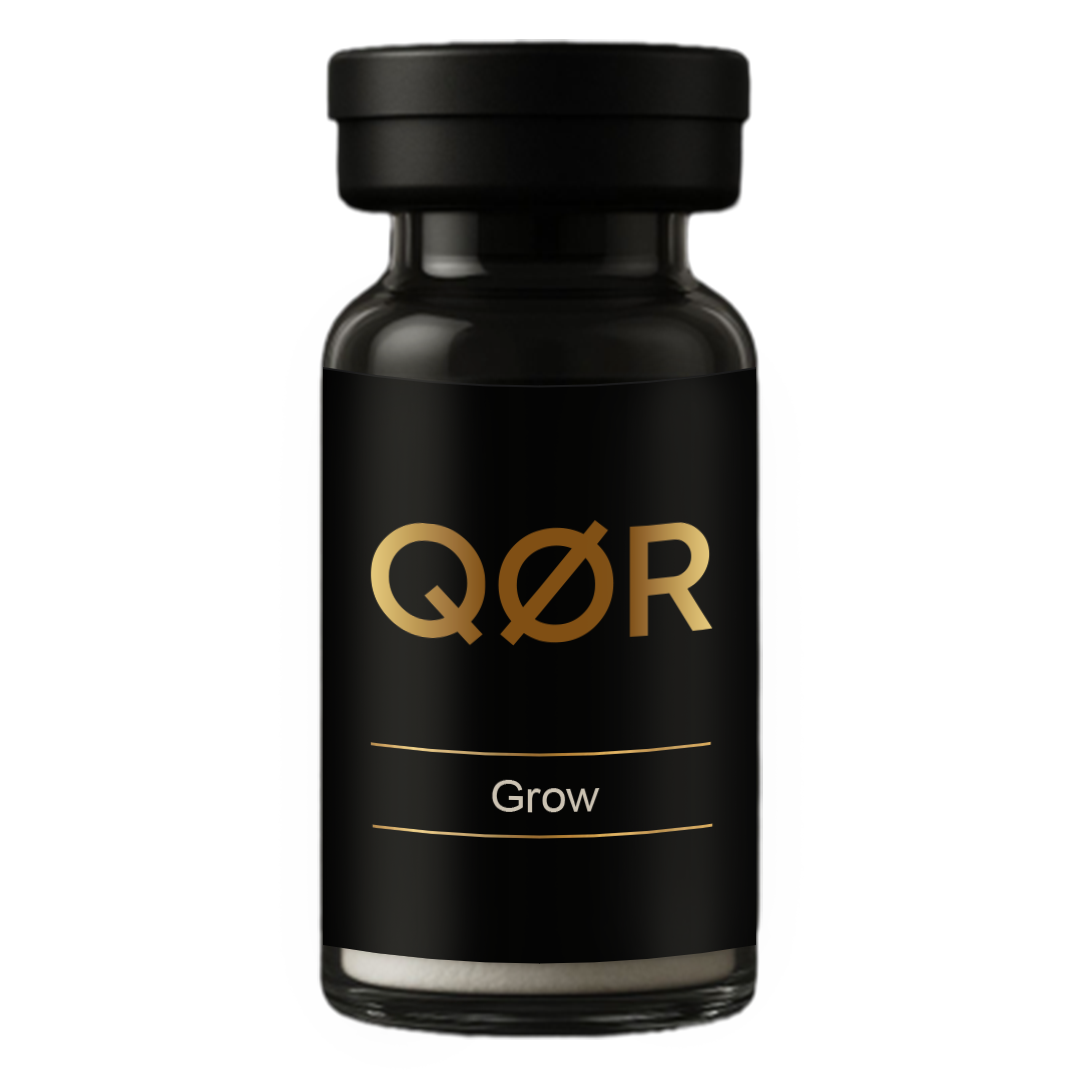
GROW Blend is a two component research formulation that combines CJC 1295 no DAC a growth hormone releasing hormone analogue and Ipamorelin a selective growth hormone secretagogue.
It is supplied as a research grade mixture for laboratories that study hypothalamic pituitary axis physiology pulsatile growth hormone release and downstream IGF 1 and metabolic signaling.
Molecular and mechanistic information
CJC 1295 no DAC is a modified fragment of GHRH designed to engage the growth hormone releasing hormone receptor with a pharmacokinetic profile that supports physiologic style growth hormone pulses rather than continuous stimulation. Ipamorelin is a selective ghrelin receptor agonist that acts at the growth hormone secretagogue receptor GHSR to promote growth hormone release with comparatively limited activity on other pituitary hormones in preclinical profiles. In experimental systems the combination of a GHRH analogue and a GHSR agonist is used to explore cooperative effects on pituitary somatotrophs. GROW Blend allows researchers to examine how dual pathway stimulation shapes the amplitude and frequency of endogenous growth hormone pulses and to map consequent changes in IGF 1 levels body composition markers and related endocrine readouts under controlled conditions. By providing both peptides in a fixed ratio formulation this blend is positioned for studies that require consistent co administration of CJC 1295 no DAC and Ipamorelin across cell based assays and in vivo models.
Intended use
GROW Blend is intended exclusively for in vitro experiments ex vivo preparations and other controlled laboratory research applications including animal studies conducted under appropriate oversight. Typical uses include growth hormone axis characterization receptor pharmacology work pituitary function studies and metabolic and body composition models that depend on endogenous growth hormone modulation.
It is not intended for human or veterinary use.
It is not intended for diagnosis treatment cure prevention or mitigation of any disease performance issue or anti aging concern.
It is not a drug food dietary supplement cosmetic or medical device.
Key features
Fixed combination of CJC 1295 no DAC and Ipamorelin for coordinated growth hormone axis research Targets both GHRH and GHSR pathways to support investigation of physiologic pulsatile growth hormone release Reduces complexity of separate peptide preparation when dual administration is required in experimental designs Manufactured under controlled conditions with analytical verification of identity and purity of each component and blend ratio
Overview
GROW Blend combines CJC 1295 no DAC a growth hormone releasing hormone analogue with Ipamorelin a ghrelin receptor agonist.
It is used in controlled models to study coordinated activation of the hypothalamic pituitary axis growth hormone pulse physiology and downstream metabolic effects.
The sections below summarise how dual GHRH and GHSR pathway activation is applied in preclinical research. All observations are model specific and do not imply any performance or anti aging claims.
1. Growth hormone releasing hormone and GHSR receptor physiology
CJC 1295 no DAC is a modified GHRH analogue engineered to support pulsatile growth hormone release patterns rather than flat continuous elevation. Ipamorelin is a selective GHSR agonist with relatively selective action on growth hormone secretion compared with other pituitary hormones. In the normal growth hormone axis GHRH neurons in the hypothalamus release GHRH which engages GHRH receptors on somatotroph cells. Separately ghrelin from the stomach and other tissues engages GHSR to enhance growth hormone release. GROW Blend enables research into how coordinated stimulation of both pathways influences the amplitude frequency and stability of endogenous growth hormone pulses in animal models and ex vivo pituitary systems. These studies help map how the dual input system maintains physiologic growth hormone dynamics compared with single pathway activation or non physiologic continuous stimulation.
. Pituitary function and growth hormone secretion dynamics
In ex vivo pituitary tissue and isolated somatotroph preparations GROW Blend is used to characterise dose response relationships and receptor cross talk.
Researchers measure growth hormone release kinetics into the incubation medium intracellular cAMP and calcium dynamics in somatotrophs somatostatin feedback effects under dual stimulation. The goal is to understand how GHRH and GHSR signaling converge at the level of the somatotroph to control hormone release in a physiologically relevant manner. Comparisons with single peptide arms and saline controls help isolate the contribution of each pathway and test for synergy.
3. IGF 1 and downstream endocrine effects
Growth hormone exerts many effects through IGF 1 which is produced primarily by the liver in response to growth hormone stimulation. Animal studies using GROW Blend typically measure circulating IGF 1 levels at multiple time points hepatic IGF 1 gene expression IGF 1 signaling marker phosphorylation in target tissues.
These measurements establish whether the dual pathway stimulation produces growth hormone pulses sufficient to drive robust IGF 1 production and whether IGF 1 responses differ from single peptide paradigms.
4. Body composition and muscle research
A major application of growth hormone axis research is understanding how changes in growth hormone and IGF 1 influence skeletal muscle and fat distribution.
GROW Blend is used in models that track muscle mass by imaging or direct tissue analysis skeletal muscle protein synthesis markers muscle strength measurements in functional tests lean mass preservation during metabolic challenges. In rodent studies CJC 1295 no DAC plus Ipamorelin is deployed to examine how dual GHRH and GHSR activation supports muscle anabolism compared with control or single peptide treated groups. These models also track markers of protein breakdown to evaluate net changes in muscle turnover.
5. Fat metabolism and body weight regulation
Growth hormone is lipolytic meaning it promotes fat mobilisation and oxidation. GROW Blend studies often measure total body fat content and regional distribution visceral versus subcutaneous free fatty acid levels and glycerol mobilisation markers hepatic triglyceride content markers of adipose tissue inflammation and metabolic dysfunction.
Dual pathway activation is explored to see whether it produces greater shifts in fat utilisation than single peptide approaches and whether these shifts occur without triggering compensatory metabolic adaptations.
6. Bone and skeletal health research
Growth hormone and IGF 1 are important regulators of bone turnover and strength. Animal models track bone density and mineral content by imaging serum markers of bone formation and resorption mechanical properties of harvested bones osteoblast and osteoclast activity markers. GROW Blend is used to investigate whether coordinated growth hormone axis stimulation produces additive effects on bone anabolism and whether dual pathway activation offers advantages over single route stimulation in models of bone loss or injury repair.
7. Metabolic hormones and metabolic flexibility
Beyond growth hormone and IGF 1 the growth hormone axis intersects with broader metabolic regulation. GROW Blend studies often include measurement of glucose homeostasis and insulin sensitivity indices lipid profiles including cholesterol and triglycerides thyroid hormone levels cortisol and other glucocorticoids glucagon and other counter regulatory hormones. These integrated profiles help define how dual GHRH and GHSR activation affects whole body metabolism rather than looking at isolated growth hormone effects.
8. Pulsatile versus continuous stimulation paradigms
A key experimental distinction is between peptides that support physiologic pulsatile growth hormone release and those that create sustained elevation.
CJC 1295 no DAC is specifically designed to preserve pulsatility. GROW Blend studies frequently compare animals dosed with CJC 1295 no DAC plus Ipamorelin against groups receiving DAC containing variants or continuous growth hormone infusions. Endpoints measure quality of life related outcomes recovery from metabolic stress and long term tolerance. This work aims to test whether preserving natural growth hormone rhythms produces better functional and metabolic outcomes than imposing artificial continuous elevation.
9. Recovery and stress resilience models
Growth hormone is known to support recovery from injury infection and metabolic stress. GROW Blend is used in models where animals undergo controlled insults such as
thermal or mechanical injury sepsis or endotoxin challenge fasting or metabolic depletion forced exercise or overtraining paradigms. Researchers measure how GROW Blend treated groups compare to controls on metrics of inflammatory resolution wound healing mitochondrial recovery and return to baseline physiology. These studies position dual growth hormone axis activation as a potential tool for understanding physiologic stress responses.
10. Receptor selectivity and off target effects
While Ipamorelin is relatively selective for GHSR it has modest activity at other receptors. GROW Blend research includes experiments to define selectivity profiles and to distinguish growth hormone mediated effects from any direct peptide actions on non somatotroph cells.
Typical approaches include
pharmacologic receptor blockade to isolate GHSR versus GHRH contributions use of receptor deficient animal models to attribute effects to specific pathways tissue specific measurements to localise where dual stimulation produces its primary effects.
Typical research applications
Across laboratories GROW Blend is commonly used in growth hormone axis physiology and pituitary function studies pulsatile versus continuous growth hormone release comparison models body composition and lean mass research bone health and skeletal remodeling investigations metabolic flexibility and whole body energy balance studies
recovery and stress resilience paradigms long term tolerance and side effect profiling of dual pathway agents. In all these contexts GROW Blend is a mechanistic research tool not a finished performance or anti aging product.
Important research disclaimer
All findings summarised here arise from in vitro systems animal models and limited translational studies under defined protocols. They are provided solely to inform qualified researchers about how GROW Blend is applied in growth hormone axis research. These observations do not show or imply that GROW Blend or its components are safe or effective for any human or veterinary indication. They are not dosing instructions medical advice or guidance for muscle building fat loss performance enhancement or anti aging use. GROW Blend is intended strictly for laboratory research applications. It is not for human or veterinary use and must not be used for diagnosis treatment cure prevention or mitigation of any disease or condition.
Store peptides only in professional, controlled environments that operate under their own safety and quality systems. All storage, handling, and disposal must follow your organization’s written policies, risk assessments, and standard operating procedures. It is the responsibility of the facility and its staff to ensure that these policies are in place, understood, and actively followed. Keep vials in a cool, dry location away from direct light, heat, and moisture. Vials should remain upright, sealed, and protected from physical impact so contents and labels stay intact and legible. If your procedures include freezing, use appropriate working volumes and avoid repeated freeze and thaw cycles of the same vial. Do not store peptides near food, drink, or general consumables. Keep them only in designated storage areas with controlled access that reflect your internal governance and regulatory obligations. Handling and preparation must be carried out solely by personnel who are trained and authorized under your institutional guidelines.
Intended use
This product is intended exclusively for in vitro experiments ex vivo preparations and other controlled laboratory research applications including animal studies conducted under appropriate oversight. Typical uses include cell culture assays biochemical experiments on copper binding and transport and investigations of extracellular matrix remodeling and tissue biology.
It is not intended for human or veterinary use.
It is not intended for diagnosis treatment cure prevention or mitigation of any disease or cosmetic condition.
It is not a drug food dietary supplement cosmetic ingredient or medical device.
Tesamorelin: A 44-amino acid GHRH analogue used to investigate growth hormone axis regulation, visceral adiposity, and neuroendocrine-metabolic interactions.
TB 500: A synthetic form of Thymosin Beta-4 used as a tool to study G-actin sequestration, cytoskeletal dynamics, and vascular remodeling in tissue models.
Recently viewed
What our customers say about us
Academic Research Center
Documentation was complete, packaging was appropriate for our facility, and delivery aligned with our internal timelines.
Private Research Organization
Consistent batch records and clear technical communication support our internal quality requirements.
Academic research center
From ordering through delivery, communication and documentation have met our institutional expectations for research materials procurement.
Private research laboratory
QØR has supplied us with consistent reference materials and clear batch documentation across multiple orders, supporting our in-house assay validation work