GLOW Blend is a multi peptide research formulation that combines three well characterized peptides
BPC 157
TB 500 Thymosin Beta 4
GHK Cu tripeptide copper complex
It is supplied as a research grade mixture for use in laboratory models that investigate tissue repair angiogenesis extracellular matrix regulation and inflammation related signaling.
Molecular and mechanistic information
BPC 157
A synthetic pentadecapeptide originally derived from a gastric protein fragment.
In preclinical systems it has been used to study angiogenesis fibroblast migration and epithelial repair with work focusing on pathways that include VEGF receptor 2 focal adhesion components such as FAK and paxillin and nitric oxide related signaling in tissue injury models.
TB 500 Thymosin Beta 4
A forty three amino acid actin binding peptide that sequesters G actin and modulates cytoskeletal dynamics.
It is widely used in research on cell migration angiogenesis through VEGF associated mechanisms progenitor cell mobilization and repair of myocardium dermis and connective tissue in animal models.
GHK Cu
A tripeptide copper complex composed of glycyl histidyl lysine bound to Cu two plus.
It is employed in studies of wound repair collagen and other matrix protein synthesis hair follicle biology and antioxidant and anti inflammatory responses including work on TGF beta signaling and matrix metalloproteinase regulation. By combining these three agents GLOW Blend allows researchers to expose tissues or cell systems to concurrent signals that act on vascular growth cytoskeletal remodeling matrix synthesis and inflammatory tone. This design supports investigation of how overlapping but distinct pathways interact to shape healing trajectories and tissue quality in controlled experiments.
Intended use
GLOW Blend is intended exclusively for in vitro experiments ex vivo preparations and other controlled laboratory research applications including animal studies conducted under appropriate oversight.
Typical applications include
multifactorial wound and incision models dermal and connective tissue repair paradigms angiogenesis and microvascular quality studies matrix remodeling and scar architecture investigations.
It is not intended for human or veterinary use.
It is not intended for diagnosis treatment cure prevention or mitigation of any disease cosmetic concern or medical condition.
It is not a drug food dietary supplement cosmetic or medical device.
Key features
Three peptide formulation combining BPC 157 TB 500 Thymosin Beta 4 and GHK Cu in a single vial
Designed for research on concurrent angiogenesis cell migration extracellular matrix production and inflammation modulation
Suited to models that evaluate musculoskeletal dermatological and post surgical tissue responses under a multi pathway stimulus
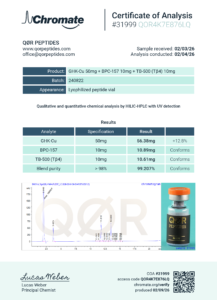
Manufactured under controlled conditions with analytical confirmation of component identity and blend composition.
Overview
GLOW Blend combines three peptides that each have established roles in tissue healing and inflammation control. BPC 157 TB 500 Thymosin Beta 4 and GHK Cu are individually used in preclinical models to study vascular growth matrix remodeling cell migration and immune modulation. The research on GLOW Blend focuses on how these three pathways interact when present simultaneously in the same tissue environment. The central question is whether coordinated activation of multiple repair mechanisms produces greater efficacy or durability of healing compared with single peptide exposures.
1. Angiogenesis and vascular development
TB 500 and BPC 157 are both employed independently in studies of new blood vessel formation. TB 500 works through upregulation of vascular endothelial growth factor and support of endothelial cell migration while BPC 157 influences VEGF receptor 2 signaling and nitric oxide pathways that regulate vasodilation and capillary extension.
GHK Cu contributes to this axis by enhancing endothelial cell proliferation and supporting pericyte recruitment and vessel maturation. In GLOW Blend models investigators can observe how simultaneous activation of these distinct vascular mechanisms influences capillary density distribution perfusion kinetics and long term vessel stability.
Typical endpoints include tube formation assays in vitro capillary counts in wound sections blood flow measurements and pericyte coverage assessment. The convergence of VEGF signaling FAK paxillin pathways and nitric oxide tone creates a more complete pro angiogenic environment than any single peptide alone can provide.
2. Cell migration cytoskeletal dynamics and fibroblast activity
TB 500 is foundational to cell migration research because it regulates actin polymerization and cytoskeletal organisation which are essential for cells to move and reshape.
BPC 157 promotes fibroblast migration through FAK and paxillin phosphorylation and influences how cells engage with and remodel extracellular matrix.
GHK Cu stimulates fibroblast function directly and modulates gene expression linked to tissue remodeling. When all three are present in a system fibroblasts have enhanced capacity for both directed migration toward injury sites and robust matrix synthesis at those sites. GLOW Blend models track fibroblast density migration speed collagen production and organisation of deposited matrix. The data typically show that multi pathway stimulation of fibroblast biology produces more rapid wound closure and more organised granulation tissue compared with control or single peptide groups.
3. Extracellular matrix synthesis and remodeling
BPC 157 and GHK Cu are both active in promoting synthesis of collagen and other structural proteins. GHK Cu specifically upregulates genes controlling collagen cross linking and interacts with TGF beta signaling which is central to fibrotic tissue organisation. TB 500 supports this process by improving the cellular machinery for synthesis and by promoting angiogenesis which brings blood supply needed to sustain matrix producing cells. In GLOW Blend experiments investigators often measure not only the speed of matrix deposition but also its architecture quality and mechanical properties. Assays include hydroxyproline content collagen type ratios fibre alignment under polarised microscopy tensile strength testing and scar versus normal tissue comparison. Results generally indicate that the combined peptide environment shifts healing toward more organised physiologic matrix rather than disorganised scar tissue.
4. Anti inflammatory and anti oxidant signaling
Each constituent peptide in GLOW Blend has been shown to influence oxidative stress and inflammatory mediator production. BPC 157 modulates reactive oxygen species and supports barrier integrity which limits inflammatory cell infiltration. TB 500 reduces inflammatory cytokine production and supports resolution of early inflammatory phases.
GHK Cu exerts direct antioxidant activity and regulates gene expression linked to oxidative stress response. These three act on overlapping but distinct mechanisms which means GLOW Blend creates a more comprehensive anti inflammatory environment than single agents. Research models track pro and anti inflammatory cytokine profiles tissue macrophage phenotypes neutrophil infiltration and oxidative stress markers such as lipid peroxidation products. In these assays GLOW Blend typically produces faster resolution of the inflammatory phase and earlier transition to the remodeling phase of healing compared with controls.
5. Musculoskeletal repair and complex injury models
In tendon and muscle injury models all three peptides in GLOW Blend are relevant. BPC 157 has been studied specifically in tendon healing where it influences collagen deposition and vessel growth. TB 500 acts on muscle regeneration through both direct effects on myogenic cells and support of angiogenesis which sustains muscle recovery.
GHK Cu promotes collagen synthesis and angiogenesis both critical for tendon and muscle healing. Researchers combine these peptides to create a complete pro regenerative stimulus that addresses the multiple biological challenges in musculoskeletal injury namely vessel growth fiber reorganisation and inflammatory containment. Typical endpoints include functional testing of strength and range of motion histologic scoring of tissue architecture immunophenotyping of infiltrating immune cells and transcriptional profiling of repair associated genes.
6. Dermatological and skin repair applications
Skin represents a complex multi layered system where epidermis dermis and microvascular compartments all require coordinated repair. GHK Cu is a particularly strong tool in skin models because it influences hair follicle biology and dermal fibroblast activity. BPC 157 and TB 500 both support angiogenesis and epithelial cell migration which are central to wound closure and skin barrier restoration. GLOW Blend experiments in dermal wounds track re epithelialisation kinetics angiogenesis depth of granulation tissue collagen organisation and long term scar appearance and flexibility. The multi peptide approach allows investigators to test whether coordinated pathway activation produces superior wound closure and better cosmetic outcomes compared with single agent or control groups.
7. Post surgical recovery and complex tissue paradigms
Post surgical wounds present a particular challenge because they involve controlled incisions through multiple tissue planes that must all heal coordinately.
GLOW Blend is well suited to these models because it addresses vascular needs matrix remodeling and inflammation across the full thickness of surgical wounds.
Researchers design protocols that mimic clinical recovery timelines and track functional outcomes alongside histologic and molecular endpoints.
Comparisons often reveal that GLOW Blend accelerates early phase healing improves matrix organisation and produces better long term mechanical properties than standard care or single peptide controls.
8. Mechanistic interrogation of pathway convergence
Beyond empirical outcome measures some research with GLOW Blend focuses on pathway interaction itself. Do BPC 157 and TB 500 enhance each others signaling at the level of growth factor receptors and downstream cascades. Does GHK Cu copper availability limit or enhance the activity of the other two peptides. Which pathways dominate at different timepoints during healing. These questions use GLOW Blend as a tool to reveal whether the three peptides show additive effects independent activation or true synergy where the combination is greater than the sum of parts. Answering these questions advances understanding of tissue repair biology and helps design future multi component therapeutics.
Typical research applications
Across laboratories GLOW Blend is commonly used in acute wound models in skin and other tissues tendon and muscle injury repair paradigms surgical incision and recovery models dermal fibroblast and angiogenesis co culture systems chronically inflamed or slowly healing tissue models comparative studies of mono peptide versus multi peptide exposure. In every case GLOW Blend is a research tool for studying tissue regeneration not a finished therapeutic or cosmetic product.
Important research disclaimer
All findings summarised here arise from controlled in vitro systems ex vivo preparations and animal models under defined protocols. They are provided only to inform qualified researchers about how BPC 157 TB 500 and GHK Cu are used in combination within experimental frameworks. These observations do not demonstrate or imply that GLOW Blend is safe or effective for any human or veterinary indication. They are not dosing instructions medical advice or guidance for wound care hair growth cosmetic enhancement surgical recovery or any other clinical use. GLOW Blend supplied is intended strictly for laboratory research applications.
It is not for human or veterinary use and must not be used for diagnosis treatment cure prevention or mitigation of any disease cosmetic condition or physical concern.
Store peptides only in professional, controlled environments that operate under their own safety and quality systems. All storage, handling, and disposal must follow your organization’s written policies, risk assessments, and standard operating procedures. It is the responsibility of the facility and its staff to ensure that these policies are in place, understood, and actively followed. Keep vials in a cool, dry location away from direct light, heat, and moisture. Vials should remain upright, sealed, and protected from physical impact so contents and labels stay intact and legible. If your procedures include freezing, use appropriate working volumes and avoid repeated freeze and thaw cycles of the same vial. Do not store peptides near food, drink, or general consumables. Keep them only in designated storage areas with controlled access that reflect your internal governance and regulatory obligations. Handling and preparation must be carried out solely by personnel who are trained and authorized under your institutional guidelines.
Intended use
This product is intended exclusively for in vitro experiments ex vivo preparations and other controlled laboratory research applications including animal studies conducted under appropriate oversight. Typical uses include cell culture assays biochemical experiments on copper binding and transport and investigations of extracellular matrix remodeling and tissue biology.
It is not intended for human or veterinary use.
It is not intended for diagnosis treatment cure prevention or mitigation of any disease or cosmetic condition.
It is not a drug food dietary supplement cosmetic ingredient or medical device.
$150.00–$350.00Price range: $150.00 through $350.00
Retatrutide: A triple receptor agonist (GLP-1, GIP, and glucagon) intended for research into metabolic signaling, glucose regulation, and energy balance.
Glutathione 1500mg: A fundamental tripeptide reagent for investigating cellular redox buffering, antioxidant enzyme kinetics, and thiol-mediated detoxification pathways.
Documentation was complete, packaging was appropriate for our facility, and delivery aligned with our internal timelines.
Private Research Organization
Consistent batch records and clear technical communication support our internal quality requirements.
Academic research center
From ordering through delivery, communication and documentation have met our institutional expectations for research materials procurement.
Private research laboratory
QØR has supplied us with consistent reference materials and clear batch documentation across multiple orders, supporting our in-house assay validation work