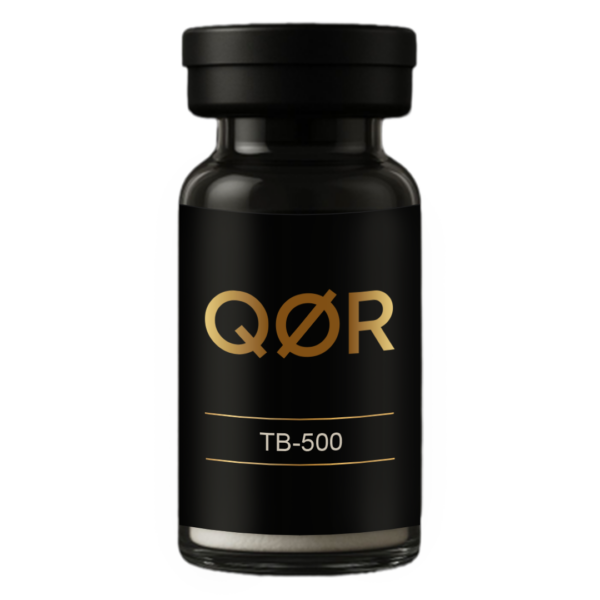
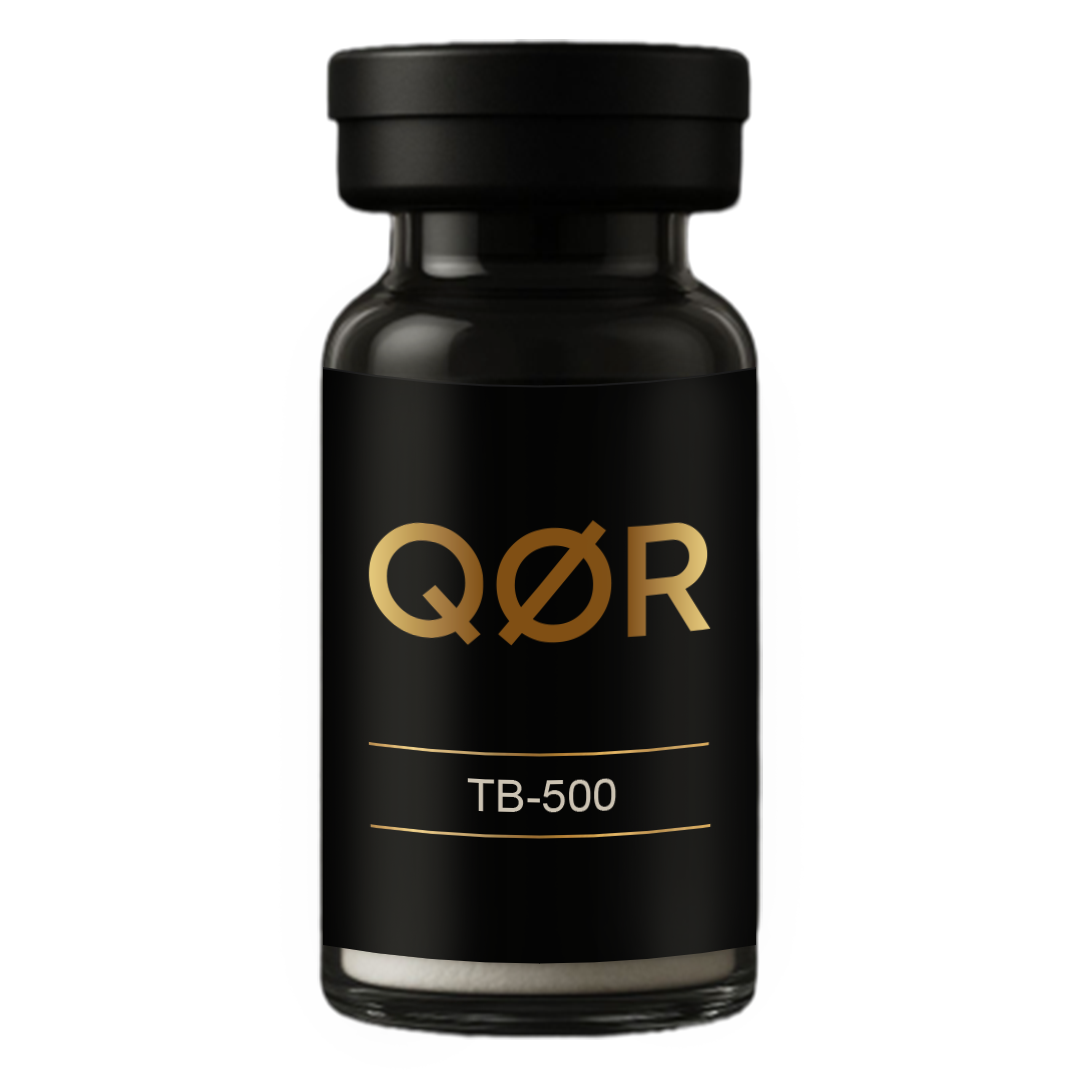
TB 500: Una forma sintética de Timosina Beta-4 utilizada como herramienta para estudiar la secuestración de G-actina, la dinámica del citoesqueleto y la remodelación vascular en modelos de tejido.
TB 500 es la forma sintética de investigación de Timosina Beta 4, un péptido de cuarenta y tres aminoácidos identificado originalmente en extractos derivados del timo y en estudios de proteínas del citoesqueleto.
Se suministra como péptido de grado de investigación para laboratorios que investigan la regulación del citoesqueleto, las vías de reparación tisular y la señalización relacionada con lesiones en modelos celulares y animales.
Información molecular y mecanística
La Timosina Beta 4 es un péptido prominente de unión a actina G que participa en el secuestro de actina y la dinámica del citoesqueleto en células de mamíferos. En sistemas experimentales se utiliza como compuesto herramienta para estudiar cómo la remodelación de actina se integra con la migración celular, la angiogénesis, la inflamación y los procesos de reparación tisular. El trabajo preclínico ha examinado TB 500 Timosina Beta 4 en modelos que rastrean el crecimiento de vasos sanguíneos, las tasas de cierre de heridas, los perfiles de señalización inflamatoria y los marcadores de daño oxidativo en tejidos cardíacos, del sistema nervioso central y periféricos.
Estos estudios posicionan TB 500 como una sonda peptídica versátil para explorar la protección, reparación tisular, regeneración y remodelación de tejidos lesionados o estresados bajo condiciones controladas.
Uso previsto
Este producto está destinado exclusivamente a experimentos in vitro, preparaciones ex vivo y otras aplicaciones de investigación de laboratorio controladas, incluidos estudios en animales bajo supervisión apropiada. Los usos típicos incluyen ensayos de migración celular, modelos de angiogénesis, paradigmas de cicatrización de heridas, investigación de biología del citoesqueleto y modelos de lesión específicos de órganos.
No está destinado al uso humano ni veterinario.
No está destinado al diagnóstico, tratamiento, cura, prevención o mitigación de ninguna enfermedad o afección médica.
No es un fármaco, alimento, suplemento dietético, cosmético ni producto sanitario.
Características principales
Secuencia sintética de cuarenta y tres aminoácidos de Timosina Beta 4 adecuada para investigación de reparación tisular y citoesqueleto Aplicable en estudios de crecimiento de vasos sanguíneos, cicatrización de heridas, inflamación y estrés oxidativo en corazón, cerebro y tejidos periféricos Fabricado bajo condiciones controladas con verificación analítica de identidad y pureza
Overview
TB 500 is the research form of Thymosin Beta 4 a forty three amino acid actin binding peptide. It is used in controlled models to study cytoskeletal dynamics tissue repair pathways angiogenesis inflammation and oxidative stress across multiple organ systems. The section below reframes the literature as context for how TB 500 is used as a tool compound. Nothing here is a usage claim and none of it should be read as guidance for clinical or cosmetic application.
1. Neurologic function and neural repair
In rodent models TB 500 has been investigated for its impact on both central and peripheral nervous system repair after injury. Studies show that Thymosin Beta 4 can activate support cells that surround and sustain neurons including oligodendrocytes and related glial populations. Activation of these support cells is associated with increased blood vessel formation and neuronal growth within injured brain regions. Behavioral testing in these models reports improvements in motor control behavior and cognitive performance that parallel the structural findings. Additional research in spinal cord injury models demonstrates that TB 500 can reduce oxidative stress markers and enhance survival of transplanted neural stem and progenitor cells. In those settings improved survival of neural precursors is linked to more robust spinal regeneration readouts positioning TB 500 as a probe for spinal cord recovery mechanisms.
2. Blood vessel growth and angiogenesis
TB 500 and Thymosin Beta 4 have been shown to upregulate vascular endothelial growth factor expression in multiple systems. VEGF is a key signaling molecule for capillary growth which is central to wound closure tissue perfusion and other regenerative processes. Beyond VEGF induction research suggests that Thymosin Beta 4 participates at several steps of vascular development including extracellular matrix remodeling vasculogenesis angiogenesis and the transition from mesenchymal cell types to specialized endothelial lineage. Loss of Thymosin Beta 4 in genetic models interferes with blood vessel formation and stability while exogenous administration improves capillary density and pericyte recruitment after injury. These findings make TB 500 a core tool for mapping how cytoskeletal regulation intersects with vascular development and maintenance.
3. Hair growth and follicle biology
Hair growth effects of Thymosin Beta 4 were identified incidentally in mouse models.
Mice genetically deficient in Thymosin Beta 4 showed markedly delayed hair regrowth after shaving compared with wild type controls. Conversely mice engineered to overexpress Thymosin Beta 4 displayed faster hair regrowth increased numbers of hair shafts and grouped follicles under histologic examination. These observations support the use of TB 500 in mechanistic studies of hair follicle cycling stem cell niches and dermal papilla interactions.
4. Antibiotic synergy and host response in infection
Multi drug resistant infections have prompted interest in host directed adjuncts that can augment existing antibiotics. In a Pseudomonas aeruginosa corneal infection model TB 4 and related peptides were tested in combination with ciprofloxacin. Mice receiving the combination showed lower bacterial colony forming units reduced neutrophil infiltration decreased reactive oxygen species and lower nitrate levels in corneal tissue compared with antibiotic alone. These data suggest that Thymosin Beta 4 based peptides can modify host inflammatory responses and improve clearance dynamics when paired with conventional antimicrobial agents.
Researchers use TB 500 in this context to study antibiotic synergy and innate immune modulation rather than as a stand alone antimicrobial.
5. Cardiovascular and renal system research
Two decades of work link Thymosin Beta 4 derivatives with multiple cardiovascular and renal endpoints. Mechanistic studies point to several concurrent actions including promotion of collateral vessel growth support of endothelial cell migration and enhancement of cardiomyocyte survival after ischemic injury. TB 500 appears to work with endogenous signaling molecules to reduce inflammation and limit fibrosis in heart and kidney models. Hydrogel systems containing collagen and Thymosin Beta 4 have been used to deliver the peptide locally to injured myocardium where they promote angiogenesis epicardial cell migration and improved functional recovery after ischemia while lowering scar burden. These models position TB 500 as a versatile tool for dissecting relationships among vascular growth inflammation fibrosis and organ repair.
6. Neurodegenerative disease and autophagy
Neurodegenerative conditions such as prion disease and Alzheimer type pathology involve accumulation of misfolded proteins in the central nervous system.
Recent work indicates that Thymosin Beta 4 can enhance autophagy the main intracellular pathway for degrading misfolded proteins in neurons. In prion related models augmentation of autophagic flux by Thymosin Beta 4 is associated with improved clearance of pathogenic protein species. This line of research uses TB 500 to probe how boosting intrinsic clearance pathways may alter progression of neurodegenerative processes.
7. Broad research applications and pharmacologic profile
Because Thymosin Beta 4 influences actin dynamics a fundamental aspect of cell structure TB 500 research spans many tissues including heart brain skeletal muscle skin cornea and kidney. Studies report minimal adverse findings in animal models along with low oral and high subcutaneous bioavailability in mice. Importantly dose levels used in mice do not scale linearly to humans which is why TB 500 remains confined to educational and scientific research settings. Work continues across multiple domains from cardiac and neurologic disease to antibiotic adjunct strategies making TB 500 one of the more intensively studied peptides in current preclinical research.
Typical research applications
Across the literature TB 500 is commonly used in central and peripheral nervous system injury and repair models angiogenesis and vascular remodeling studies hair follicle cycling and dermal regeneration research infection models examining antibiotic synergy and host response cardiovascular and renal injury repair and fibrosis studies
neurodegenerative disease models focused on autophagy and protein clearance. In all of these contexts TB 500 functions as a mechanistic research tool not as a finished therapeutic agent.
Important research disclaimer
All findings summarised here arise from in vitro systems animal models and early translational studies under defined protocols. They are provided only to inform qualified researchers about how TB 500 and Thymosin Beta 4 are applied in experimental work. These observations do not demonstrate or imply that TB 500 is safe or effective for any human or veterinary indication. They are not dosing instructions medical advice or guidance for treatment of injury infection cardiac disease neurodegeneration hair loss or any other condition. TB 500 available from a research supplier is intended strictly for laboratory research use.
It is not for human or veterinary use and must not be used for diagnosis treatment cure prevention or mitigation of any disease or condition.
BPC 157: Un pentadecapéptido sintético utilizado en modelos de laboratorio para investigar la angiogénesis, la migración de fibroblastos y la integridad de la barrera mucosa.
Glutatión 1500 mg: Un reactivo tripéptido fundamental para investigar el tamponamiento redox celular, la cinética de enzimas antioxidantes y las vías de desintoxicación mediadas por tioles.
KPV 10 mg: Un fragmento de alfa-MSH acetilado utilizado como herramienta de investigación para indagar en las vías de señalización inflamatoria y los mecanismos de transporte epitelial.
$175.00-$275.00Rango de precios: desde $175.00 hasta $275.00
NAD: Una coenzima metabólica central utilizada en ensayos de laboratorio para estudiar la bioenergética mitocondrial, la actividad de las sirtuinas y las vías de señalización dependientes de NAD.
Vistos recientemente
Lo que nuestros clientes dicen de nosotros
Laboratorio de investigación privado
QØR nos ha suministrado materiales de referencia consistentes y documentación de lote clara en múltiples pedidos, lo que respalda nuestro trabajo interno de validación de ensayos
Centro de investigación académica
Desde el pedido hasta la entrega, la comunicación y la documentación han cumplido nuestras expectativas institucionales para la adquisición de materiales de investigación.
Organización privada de investigación
Registros de lote coherentes y una comunicación técnica clara respaldan nuestros requisitos internos de calidad.
Centro de Investigación Académica
La documentación estaba completa, el embalaje era adecuado para nuestras instalaciones y la entrega se ajustó a nuestros plazos internos.