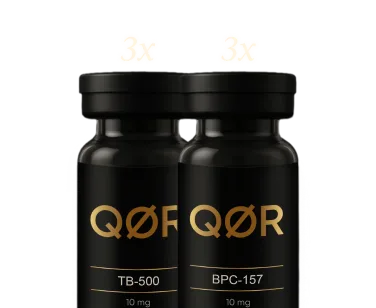
TISSUE REPAIR PATHWAY RESEARCH SET (1 MONTH) is an in vitro bundle for laboratories that want focused access to two widely studied peptides in connective tissue and repair related models. The set contains
3 × BPC157 10 mg
3 × TB500 10 mg
Each vial carries clear lot and strength information so your team can record it once and reference it accurately in protocols, plate maps, and reports. All components are supplied for in vitro research and laboratory development only and are not for human or veterinary use.
When scientists look at tissue repair pathways, they are interested in how cells coordinate damage control, clean up, and rebuilding. Connective tissues like tendons, ligaments, and fascia depend on the timing and quality of these signals. Peptide tools such as BPC157 and TB500 give researchers a way to probe these processes in cell and tissue models without ever moving into clinical use.
With a set like this, a lab can
Study how BPC157 and TB500 influence cellular behaviors that matter for structural integrity in vitro such as fibroblast migration, extracellular matrix production, or angiogenic signaling
Compare changes in markers linked to inflammation, remodeling, or matrix turnover when each peptide is introduced alone under matched assay conditions
Design experiments that test different exposure schedules and concentrations to map how cell populations respond over time in controlled environments
Use these peptides as defined inputs when developing or refining assays that track repair related pathways so detection limits, variability, and reproducibility are understood before unknown samples are evaluated
For someone outside the lab, the simple idea is this
Researchers are trying to understand how tissues organize repair at the microscopic level. When those processes are mapped clearly in preclinical systems, future teams can design experiments and interpret repair related data with more confidence and fewer assumptions. Any possible help to human health sits several stages away and depends on much larger programs that include translational work, clinical trials, and strict regulation.
Our role is to supply consistent BPC157 and TB500 materials and documentation so early questions about tissue repair pathways can be asked cleanly in vitro. We do not test or promote these materials for direct use in people or animals.
All work with this set must stay within institutional approvals, safety systems, and non clinical frameworks.
Store peptides only in professional, controlled environments that operate under their own safety and quality systems. All storage, handling, and disposal must follow your organization’s written policies, risk assessments, and standard operating procedures. It is the responsibility of the facility and its staff to ensure that these policies are in place, understood, and actively followed.
Keep vials in a cool, dry location away from direct light, heat, and moisture. Vials should remain upright, sealed, and protected from physical impact so contents and labels stay intact and legible. If your procedures include freezing, use appropriate working volumes and avoid repeated freeze and thaw cycles of the same vial.
Do not store peptides near food, drink, or general consumables. Keep them only in designated storage areas with controlled access that reflect your internal governance and regulatory obligations. Handling and preparation must be carried out solely by personnel who are trained and authorized under your institutional guidelines.
Store peptides only in professional, controlled environments that operate under their own safety and quality systems. All storage, handling, and disposal must follow your organization’s written policies, risk assessments, and standard operating procedures. It is the responsibility of the facility and its staff to ensure that these policies are in place, understood, and actively followed.
Keep vials in a cool, dry location away from direct light, heat, and moisture. Vials should remain upright, sealed, and protected from physical impact so contents and labels stay intact and legible. If your procedures include freezing, use appropriate working volumes and avoid repeated freeze and thaw cycles of the same vial.
Do not store peptides near food, drink, or general consumables. Keep them only in designated storage areas with controlled access that reflect your internal governance and regulatory obligations. Handling and preparation must be carried out solely by personnel who are trained and authorized under your institutional guidelines.
$2,350.00Original price was: $2,350.00.$1,880.00Current price is: $1,880.00.
Recently viewed
What our customers say about us
Academic Research Center
Documentation was complete, packaging was appropriate for our facility, and delivery aligned with our internal timelines.
Private Research Organization
Consistent batch records and clear technical communication support our internal quality requirements.
Academic research center
From ordering through delivery, communication and documentation have met our institutional expectations for research materials procurement.
Private research laboratory
QØR has supplied us with consistent reference materials and clear batch documentation across multiple orders, supporting our in-house assay validation work